General information
For a (fun) new project we are looking for tattoo artists who want to help us out! It will be a relatively large project, for which there will be a fee available.
Are you a professional tattoo artist in The Netherlands and would you like to help us? Send an email to juul@hetactiefonds.nl and we’ll explain everything there.
Update · GIEI report on the assassination of Berta Cáceres
Berta Cáceres was an influential Honduran environmental activist, who, after many threats on her life, was assassinated in her home on the 3rd of March, 2016. Het Actiefonds has been involved in the struggle for justice and truth on this case, and would like to reiterate our standing solidarity with grassroot groups and movements. The Interdisciplinary Group of Independent Experts (GIEI) has been carrying out an investigation on Berta Cáceres’ death, and has recently published the following:
General information
The murder of Berta Cáceres was not an isolated incident or a spontaneous crime. It was the culmination of a prolonged process of structured violence, persecution, and criminalization against an indigenous Lenca woman who was the leader of COPINH and who defended the territory, the Gualcarque River, and the rights of her people against the Agua Zarca hydroelectric project, which was imposed without consultation and supported by business, state, and financial interests.
The report by the Interdisciplinary Group of Independent Experts (GIEI) confirms that the murder of Berta Cáceres was the result of a criminal operation carried out by a broad criminal structure involving hitmen, military personnel, directors and employees of the Atala Zablah family’s company.
As part of the international investigation, it was established that Honduran officials were aware of the crime but took no action to prevent it.
Truth and Justice for Berta and defenders of the territory
The GIEI documented that funds from international development banks (The Dutch Entrepreneurial Development Bank FMO and the Central American Bank for Economic Integration-BCIE) were systematically diverted to finance illegal surveillance, armed structures, intimidation operations, and, ultimately, the murder of Berta Cáceres, revealing a pattern of corporate and financial criminality that operated with high levels of impunity and with the active or passive complicity of public institutions responsible for preventing, investigating, and punishing violence.
Almost ten years after Berta’s murder, the structural causes that made it possible persist: the lack of recognition of the Lenca indigenous territory in Río Blanco, the continued validity of the Agua Zarca project concession, the absence of sanctions against all those responsible the intellectual and financial authors—and the lack of comprehensive reparations for the victims and affected communities.
The GIEI report is a fundamental milestone for truth and justice for Berta and defenders of the territory in Honduras and Latin America. The report also makes clear demands on the Honduran state, businesses, and financial institutions to guarantee justice, reparation, and guarantees of non-repetition.
What is the GIEI?
This investigation is the result of a year of work by the GIEI, a group of three experts established in February 2025 to provide international technical assistance from a human rights perspective to the Honduran state authorities responsible for conducting the investigation into the intellectual authors (masterminds) and related crimes of the murder of Berta Cáceres.
The GIEI in Honduras is the fourth to be established in Latin America following formal agreements between the Inter American Commission on Human Rights (IACHR), the states of the region, the victims and their representatives, as an independent and impartial body for technical investigation into serious human rights violations. Previously, Independent Groups have enabled rigorous investigations into cases such as the disappearance of 43 students in Ayotzinapa, Mexico; crimes against humanity perpetrated in 2018 in Nicaragua; and acts of violence in Bolivia in 2019.
In the case of Honduras, the GIEI had a 12-month mandate that included: 1) Conducting a technical analysis of the lines of investigation to determine the criminal responsibilities of state and non-state actors; 2) Conducting a comprehensive technical analysis of the investigation into related crimes, including acts of corruption and economic or financial crimes; and 3) Developing a Comprehensive Reparation Plan for Victims to include affected communities and ensure the non-repetition of such acts.
The report includes key findings regarding those responsible for the murder of Berta Cáceres, as well as recommendations for ensuring justice and reparation that the State of Honduras has committed to adopt.
Think outside of the (ballot)box and donate to Het Actiefonds
Think outside the (ballot)box and donate to Het Actiefonds. This way, you’ll support direct action and make the world a little better!
General information
Another national election has taken place in the Netherlands, and once again the progressive left failed to win. Despite D66 surpassing the PVV by a few thousand votes, the far right has more seats than ever before. When D66 keeps considering a government with right-wing parties like the CDA and VVD, their so-called “centrist” policies would be of no use to us. Globally, we are also seeing a political shift to the right, which is increasingly jeopardizing equality, solidarity, and freedom. Human rights are being increasingly restricted everywhere, including in the Netherlands. The right to demonstrate is being curtailed, trans and queer rights are suddenly being questioned again, climate measures are being weakened or scrapped altogether, and even politicians who used to be considered near-left are now proposing overt right-wing populist ideas.

Fortunately, politics doesn’t end with the elections. The demonstrations for Sudan and Palestine are political, engaging in conversations with people who voted for the far right out of ignorance is political, distributing food to those who are underprivileged is political, donating money to charities is political, and above all: carrying out (or supporting) direct action is political!
Het Actiefonds has been supporting the most radical actions around the world since 1968, because we believe in a better world that can never be achieved solely within established politics. Recently, for example, we have supported an action group campaigning against the censorship of the true number of missing people in Mexico. We also supported a disruptive action at Kieler Woche, where the German navy attempted to normalize military presence, but the action group resisted by, among other things, spray-painting the boats. We also supported the group Stop EACOP, which is campaigning in Uganda against an oil pipeline that will displace more than 100,000 people from their land and destroy nature reserves.
Activists worldwide have never let disappointing election results deter them, and we will always support them. This is why we ask for your support. Think outside the (ballot)box and donate to Het Actiefonds. This way, you’ll support direct action and make the world a little better!
For this campain you can now order stickers and posters!
“The economy and morality of capitalism are destroying our people” – Letter from the frontline in Indonesia
The 2025 protests in Indonesia do not only call out specific government policies, but are a reaction to the everyday reality of our capitalist world. Het Actiefonds stands in solidarity with our Indonesian partners and comrades in our shared struggle for a just world!
General information
The right to protest is a human right!
Protect the right to protest now, if ever
General information
On Jan. 22, 2025, the Tweede Kamer debated the right to protest. Or rather, restricting it.
What began as an ode to this fundamental right by Teunissen (Party for the Animals) asking the ultra-right coalition whether it is willing to continue to guarantee this right in accordance with The European Convention on Human Rights, quickly lapsed into an unequivocal “no.” Their reasoning was summarized in an article in the newspaper Het Parool of the same day (“Coalition: limit right to protest for ‘misuse small group’”). However, this framing, and the proposals associated with it, are a dangerous step in the playbook of authoritarian movements.
Anyone who listened to the nearly eight hours of tirades by right-wing politicians must conclude that the government is particularly targeting activists classified as “leftists” (with the exception of farmers’ protests). These are people who a) protest against inadequate measures to avert a climate catastrophe, b) want to stop the deliberate starvation and destruction of a people with Dutch weaponry, and c) want to warn for the consequences of a far-right government. But while the selective outrage against activists seems to be based on the content of their struggle, no mention is made by the ruling parties of the victims of such policies.
The restriction is justified by the existence of “a small group” of people bent on “subversion” and “disruption.” But the very act of singling out a group in those terms should set off alarm bells. Many of the proposed measures may seem harmless to those who believe they have “nothing to hide,” but are in fact ways to map out and weaken activists: identification requirements, bans on face coverings, and stopping so-called “disruptive” actions. And this should be of enormous concern to all of us.
The Action Fund is familiar with the dangers of dictatorial ideologies. For 57 years, we have worked closely with activists around the world who challenge power and provide the dissent that makes necessary social change possible. Almost always, they are branded troublemakers by their governments, until their actions are celebrated as historic victories. These patterns are predictable to the extent that experts also speak of a far-right playbook. And while two situations are never exactly the same, there are certainly characteristics that one would do well to be alert to and act upon appropriately.
And the demonization, criminalization and isolation of leftist movements are certainly among them – as are the scapegoating of a cultural-religious or ethnic group, the proliferation of conspiracy theories and dogwhistles and the normalization of ‘us vs. them’ and war rhetoric.
In the Netherlands, a conversation about the dangers of the extreme right quickly gets bogged down in the question of whether or not a right-wing extremist leader is the literal reincarnation of a National Socialist. In a context where the singularity of World War II is emphasized in education, this is understandable. In this case, however, we fear that it gets in the way of adequately responding to and preventing a multiplicity of repressive and colonial regimes as well as preventing us from really asking what the lesson of historical fascism could be. We live in the now, where repressive regimes founded in white-nationalist ideology are already active on the world stage. In an era of Big Tech, Trump and nauseating gestures by the richest man on Earth, curtailing the right to protest really is the last thing we need. “What we are witnessing now is the government trying to put all kinds of restrictions and that is extremely worrisome,” says attorney Willem Jebbink in De Nieuws BV on January 22nd, 2025.
In January 1946, Niemöller, looking back on the step-by-step implementation of an authoritarian and white-supremacist regime, preached: “First they came for the Communists, and I did not speak out—
Because I was not a Communist. (…) Then they came for me—and there was no one left to speak out for me.” It was an insight that came too late, and can only serve as a warning for situations in the future.
A future in which history never repeats itself, but now and then can rhyme. So when Eerdmans of the far-right party JA21 talks about separating the “anarchists” from the “law-abiding citizens,” and the VVD wants to “zoom in on a small group” that wants to “destabilize civilization” while racialized and exploited groups are pitted against each other in every possible way, the least we can do is be alert.
Yes, many people in the Netherlands see activists primarily as a nuisance, a bunch of loud barkers that might make you arrive at work twenty minutes late. The French revolution could take place right before our eyes and still we would dismiss it as a bunch of troublemakers and vandals. That many of the things we take for granted, such as the weekend, safe bike lanes or an end to apartheid, have consistently been obtained thanks to order actions that disrupted the status quo is conveniently glossed over – and this is what far-right politicians are anticipating on.
Activism? Annoying.
Until one day it’s about you, your neighbour or your father and you suddenly understand what those activists were so angry about.
And then we’ll be hoping that there are still people left who want to protest on our behalf.
Give an action as a gift!
The gift for everyone who has everything but what we all really need: a better world. With this gift, contribute not to overconsumption and climate change but to the global movement for change and solidarity!
General information
A present for everyone!
Our hearts yearn for a world without exploitation and violence, and on our wish list we wrote down that we want a future where power lies with the people and everyone can live in freedom and security without depleting the planet in the process.
This gift will be used to paint banners, buy climbing gear, print pamphlets and everything else necessary to take action.
So don’t know what to give? Do you have an activist in your life who wants nothing but the revolution? Want to give your right-wing uncle a gift that won’t make him happy but will make you happy?
Then gift an action with The Action Fund’s action gift coupon!
How it works
- Make a donation! You choose an amount yourself. This can be done via the website, or you can transfer it yourself to NL46 TRIO 0338 6220 39.
- Print the action-gift coupon.
- Fill in the voucher and wrap it as you see fit.
Het Actiefonds is Looking for Allies
Het Actiefonds needs at least 500 new donors to meet the growing demand.
General information
Reasons to resist
2024 is a record year. From record temperatures to an unprecedented number of requests at Het Actiefonds. On one hand, this is bad news: there are a lot of reasons to get into action. We see a global expansion of far-right governments, from Argentina to Slovakia.
We are being pitted against each other. Racist ideologies are given free rein. Additionally, we are witnessing the resurgence of military aggression for profit. People are still being killed because they live in countries where oil, gas, or gold is found in the ground. This comes along with the escalation of the climate catastrophe, with increasingly extreme weather worldwide. Records are being broken one after the other, and the warnings from scientists are gradually becoming reality. These are all significant threats that are leading us toward global destruction.
Brave People
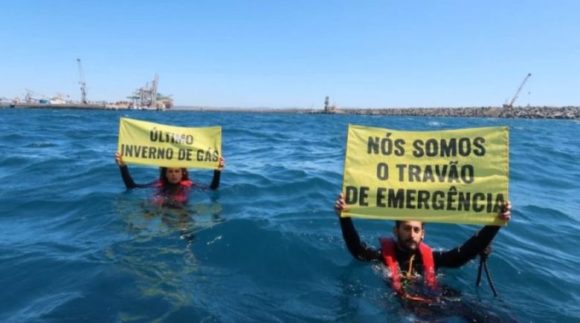
Disrupting the destructive systems that create these threats is essential for our collective survival. This brings us to the good news: all over the world, brave people are rising up to resist. Despite everything, people are committing themselves to a livable world for everyone. Social movements are not giving up and are holding on to each other. This combined strength is the only thing that can stop the destructive systems.
Helping Out
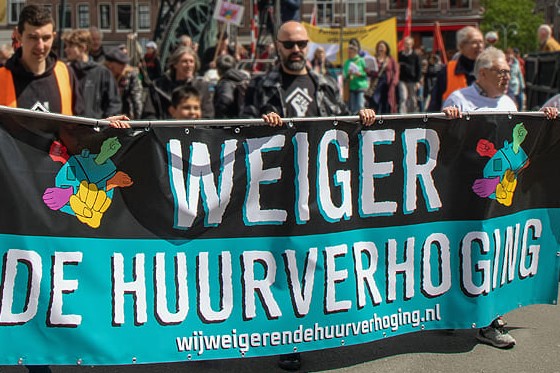
As a result, Het Actiefonds is seeing a growing number of requests for assistance. These come from activists who are themselves in difficult financial situations and yet make time to work for their community and against the systems that are destroying our planet.
For over 55 years we have stood against apartheid, for justice, and for solidarity. Because the freedom of one person is connected to the freedom of another. It is solely thanks to donors that we can contribute to global change.
Together with you, we stand with the people at blockades. For those who chain themselves to trees out of radical love for life. For the participants in mass demonstrations who raise a collective fist against structural violence. That’s why we are now looking for at least 500 allies to join Het Actiefonds. Most of our allies donate between 5 and 15 euros per month.
Rise up! Join Het Actiefonds!
EU pays Tunisia to let migrants die in the desert instead of European waters
For the first six months of 2023, the collective Alarm Phone had contact with as many as 539 boats in emergencies – roughly four per day. Alarm Phone tracks the territorial waters these boats are in, and then alert the Coast Guard to their responsibility to rescue people in distress.
General information
CW: (Sexual) violence, death
Distress call during a celebration
On July 18, a day after Mark Rutte, Giorgia Meloni, Ursula von der Leyen and Kais Said clinked glasses in Tunis over their brand-new migration deal, Alarm Phone received the following report:
“We are not doing well. We were attacked by armed soldiers. Libyan troops shot at us, beat us up, and raped the women at night. I almost ran out of battery.”
The EU promised President Said as much as a billion euros as long as he ensured that people would no longer cross the Mediterranean illegally from Tunisia. The EU is happy to cooperate with a man who seized power only two years ago, and since then has accused black migrants of demografically replacing Tunisians in his speeches.
Meloni’s Migration Deal
After all, it does not look good for the EU if hundreds of people a year drown in the Mediterranean Sea because of European regulations. Hence the deal with Tunisia. Couldn’t Said be so nice as to let migrants die in the desert instead of at sea? At least then it won’t be Europe’s responsibility anymore. If this deals result in fewer migrants on the Mediterranean, it should serve as a blueprint for similar deals with Morocco and Algeria. A situation that would greatly benefit the European right. They can then portray North Africans as vicious racists a few years from now without getting their hands dirty themselves. Indeed, they will once again present their own asylum policy as the epitome of humanism and civilisation.
Perhaps most blatantly, the deal is phrased as a humanitarian landmark. Tunisia will guarantee the human rights of migrants, European leaders vow, despite all evidence to the contrary. The report above is just one of many that Alarm Phone received this summer: and news of the hundreds of black migrants chased into the desert in July after a pogrom in Sfax reached every major European newspaper. Rutte and Meloni know who they are entering in business with.
Proponents of the deal nevertheless claim it is necessary to combat illegal human smuggling. It would all be for the safety of that migrant being whisked away by smugglers for a life-threatening boat trip. That the EU contributes to life-threatening escape routes by carrying out illegal push-backs is an uncomfortable but necessary side effect, according to proponents. After all, the Union prefers not to have drowning deaths in its own waters. How considerate.
If the EU is so concerned about migrant safety, why doesn’t it build a bridge?
Alarm Phone
For years, Het Actiefonds has supported the collective Alarm Phone, a group of volunteers documenting the crossing of the Mediterranean Sea. Migrants call Alarm Phone to relay their situation and location, upon which the collective verifies the waters they are in and thus who is responsible for their safety. In this way, Alarm Phone puts pressure on the relevant authorities to rescue migrants in mortal danger. In the first six months of 2023, Alarm Phone was in contact with as many as 539 boats in distress – roughly four per day.
Alarm Phone has since become a regular part of reporting on disasters in the Mediterranean Sea (and North Sea). For example, the organization was in contact several times with the overcrowded fishing vessel that sank off the coast of Greece in July, leaving hundreds dead and missing. Despite attempts by Greek authorities to cover up the affair or blame it on human smugglers, it seems that it was the Coast Guard itself that caused the ship to capsize. Apparently, Greek authorities tried to use a tow rope to drag the boat into Italian waters.
In the Mediterranean, truth is often an afterthought. Hence the importance of organizations like Alarm Phone, which record the facts while the are still happening. Whether European countries do anything with those facts in time is another matter. 90 percent of the emails that Alarm Phone sends to coast guards, detailing the location and status of boats in danger, go unanswered.
Read-in at the European Parliament
As a protest against the EU’s frosty attitude, Alarm Phone therefore read out 1338 emails to the European Parliament in late June with reports of boats in danger. There was also an Alarm Box present at the protest: an alarm that went off live whenever a new emergency was reported to Alarm Phone.
Alarm Phone is one of the few organizations that understands what is going on at the borders of Fortress Europe and identifies its crimes. Therefore, we are proud to once again support this group.
Image: Watch the Med – Alarm Phone
‘Crazy for this Democracy’ — On the protests against the new Israeli government
For years, Het Actiefonds has supported various actions on the occupied territories between the Jordan River and the Mediterranean Sea: from conscientious objectors to the recording and disseminating of colonial violence. Just as the most right-wing government in Israel’s history takes office, Het Actiefonds will continue to support those working for freedom and equality in occupied Palestine.
General information
More protests, more violence
Since the COVID pandemic, Israeli anti-government protests have been a recurring phenomenon. First the protests were about Prime Minister Benjamin Netanyahu’s corruption scandals or draconian pandemic policies. Netanyahu risks 10 years in prison for corruption charges, so he is desperately trying to stay in power to retain immunity. To save his own skin, he even decided to form a coalition with Israel’s far-right parties after the last election.
This monster coalition is the target of the current protests in ’48 territory (which does not include the West Bank, Gaza and East Jerusalem). Many note the dangers of making so many concessions to the far-right religious parties. For example, far-right provocateur Itamar Ben-Gvir has been appointed head of the Israeli police in the West Bank. Multiple human rights organizations already describe the situation in the West Bank and Gaza as apartheid, but if it is up to Ben-Gvir, the colonization of the West Bank is not moving fast enough. He is regularly seen at such sensitive sites as the Temple Mount and Hebron, holy sites for the religions of Abraham, declaring that the area belongs only to Jews.
Additionally, 2022 made for an especially deadly year in the region. 144 Palestinians were killed by the Israeli state in the West Bank alone, the highest number since the Second Intifada of 2004. Meanwhile, 31 Israelis lost their lives to Palestinian resistance fighters, the largest number in seven years.
Illiberal democracy
But increasing violence in the West Bank is not the sole cause for protest. Current demonstrations in the ’48 territory are largely about the attack on the rule of law. The new government wants to make the weak separation of powers in the Israeli state a thing of the past.
The new government’s most controversial plan is to give a minimum majority in parliament the power to override Supreme Court rulings. In practice, this means that the government no longer has to listen to the court, and can introduce laws that go against Israel’s constitutions. The result is unbridled power for the government, which no longer has to answer to anyone. In addition, the government wants the exclusive right to appoint lawmakers and judges, further subordinating the legal branch of the state to politics. Israel risks becoming an illiberal democracy because of the government’s new plans, following the example of Poland and Hungary. The destruction of the justice system may keep Netanyahu out of jail, but it will certainly further isolate the state.
As such, tens of thousands of people are taking to the streets in Tel Aviv, Haifa and other cities. Most of the protesters are doing so out of nationalist sentiment. For example, one lawyer told the Israeli newspaper Haaretz, “my late grandmother came to Israel in 1922 to establish a state. These days they are trying to destroy her life’s work, and I am trying to not let them succeed.”
What democracy?
Still, the demonstrations to protect Israeli democracy must be a strange sight for Palestinians. Those with Israeli passports have endured a tyranny of the majority for decades. Their interests do not align with the vast Jewish majority in ’48, giving them little political power. In East Jerusalem, the West Bank and Gaza, Palestinians do not even have the opportunity to vote.
In 1945, Black American author Zora Neale Hurston wrote the essay “Crazy for this Democracy,” whose opening lines must still sound painfully relevant to Palestinians:
“They tell me this democracy form of government is a wonderful thing. It has freedom, equality, justice, in short, everything! Since 1937 nobody has talked about anything else (…) The radio, the news papers, and the columnists inside the newspapers, have said how lovely it was. All this talk and praise-giving has got me in the notion to try some of the stuff. All I want to do is to get hold of a sample of the thing, and I declare, I sure will try it. I don’t know for myself, but I have been told that it is really wonderful.”
Decolonization
Maybe Israeli democracy will survive this government. But the country’s fundamental problem remains untouched. A colonial situation is unsustainable, and sooner or later, whether peacefully or violently, it must come to an end.
Jewish-Tunisian author Albert Memmi described the unsustainable colonial situation in The colonizer and the colonized (1957). According to him, the colonial system robs both the colonizer and colonized of their humanity. The colonizer becomes ruthless and racist because of the system. He/she/they must humiliate the colonized, deprive him/her/them of their past and future and deny them their culture and right to life. The colonized, on the other hand, has no chance to become a full human being in a system that stifles their agency as much as possible.
It is on behalf of both Israelis and Palestinians that the colonial system must be dismantled. Any peace process is a joke as long as it does not meet this first fundamental demand: an end to apartheid, an end to the colonial system.
Image: Haggai Matar / +972 Magazine
UPDATE • Lützerath stays!
More than a year ago, Het Actiefonds supported the occupation of Lützerath. The German village was in danger of being wiped off the map so that coal giant RWE could continue digging for lignite in the Rhineland. Sixteen months later, Lützerath is still on the map, but excavators are approaching the village again.
General information
Anyone who traverses the German Rhineland by car can marvel at the huge craters that dominate the landscape. The holes are so deep and large that for a moment you imagine yourself on another planet. The driver sees only dust and stone as far as her gaze reaches. The Garzweiler mine, for example, has an area of 48 square kilometers, twice the size of the municipality of Leiden. And that’s not even the largest. Right next door is the Hambach mine, with its 85 square kilometers one of the largest lignite mines in Europe.
Together, these two mines are already responsible for 75 million tons of CO2 emissions per year. By comparison, that’s about half of the Netherlands’ annual emissions. Half. And if it’s up to the energy company RWE, that number won’t go down any time soon.
Lützerath bleibt
Eckhardt Heukamp was already the last resident of Lützerath in September 2021: the other residents had been bought out or left. Yet Heukamp refused to leave the land on which he had grown up. Through a long campaign by climate activists, Heukamp and hundreds of activists managed to postpone the destruction of the village for more than a year!
But today, German police began evacuating the village. Let that sink in for a moment: the German state sends police to remove citizens from their own land so that an energy company can make even more profit from outdated fossil fuels. A police force, which, by the way, is funded by the taxes of German citizens and not those of the tax-dodging RWE. Last night the police have already cleared 200 activists. An equal number is still at the scene.
Nigerian climate activist Peter Donatus sees the same politics in the Rhineland as in the Niger Delta: “It is the same methods and the same multinationals working to destroy the environment around the world.” He advocates climate justice. Donatus: “Climate justice is a concept from the Global South, born of necessity. I am happy to see young European activists adopting our concept, but then they must also be able to see from our perspective.” Racism in the climate movement remains, he observes, “we still have a long way to go.”
RWE and the Greens
The renewed interest in the ground below Lützerath comes from the energy crisis Germany has been in since the Ukraine war. More than half of Germany’s natural gas was imported from Russia. To become more energy independent, the government has pledged to keep some nuclear power plants running longer, as well as to mine more lignite. The Greens, one of the current ruling parties, defend the end of Lützerath by pointing out that in exchange for this area, the Garzweiler mine must close eight years earlier, in 2030.
But climate activists are not impressed by this argument. They claim that the Greens have been guided by erroneous calculations by RWE itself. Politicians should have commissioned independent research into the costs and benefits of Lützerath earlier. That would have shown that it makes little sense to destroy a large area of land for a few years of coal extraction. That is, if it stays at just a few years: the history of climate goals teaches us not to take promises from energy giants so seriously. It’s about the first thing polluting companies ask for: pollute more now, in order to suddenly be completely sustainable in the future. So far, no one has successfully performed this magic trick.
The end of Lützerath might be near, but the climate battle in the Rhineland has proven effective time and again against RWE. Like the Hambach Forest before, Lützerath has quickly become a symbol of the struggle against energy companies, profit-oriented thinking, and disastrous geopolitical games. Hambi stayed! Lützi stays too!